


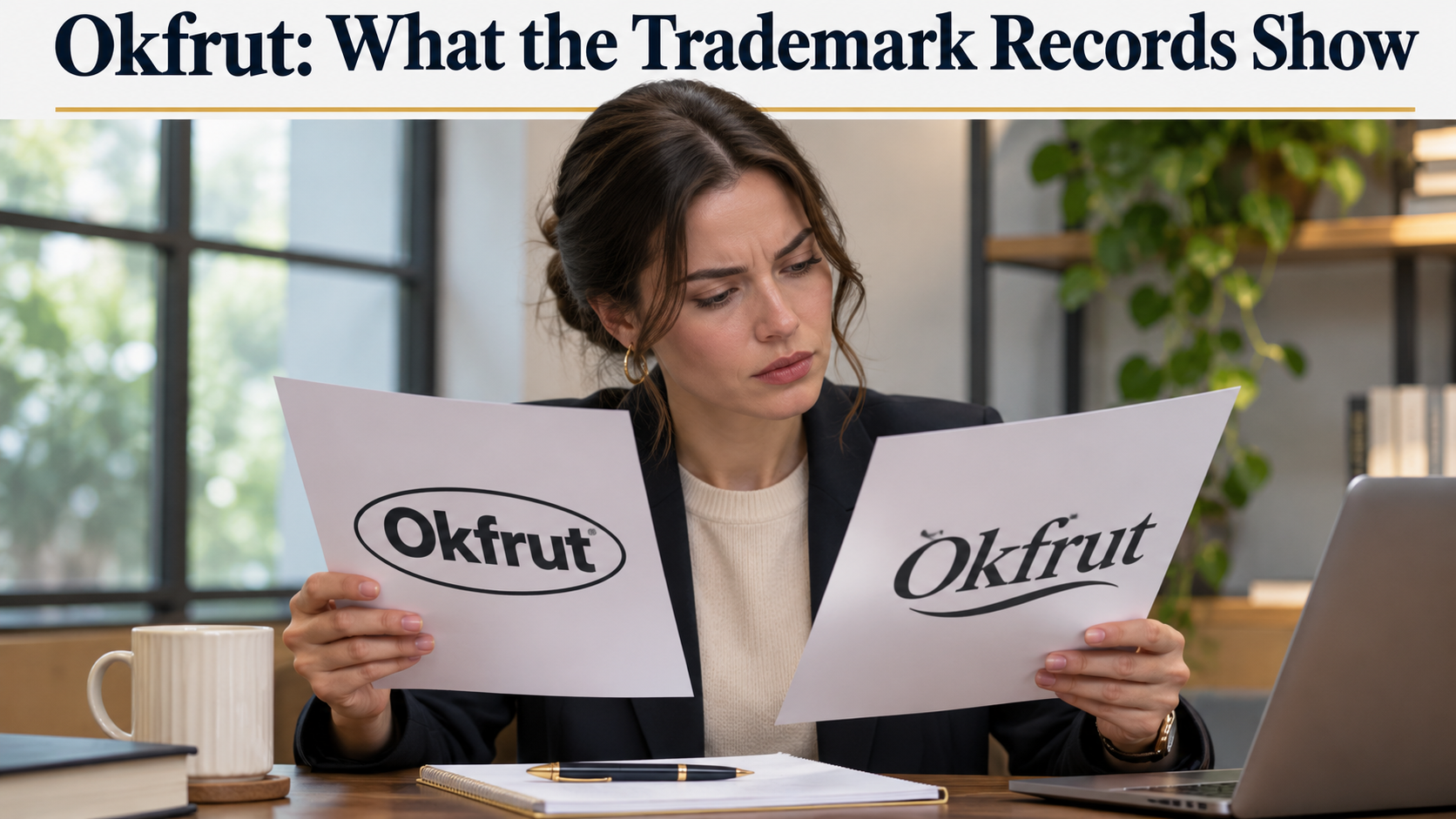
Okfrut appears in US trademark records connected with Whole Fruit JPC and fruit-flavoured beverages. Two records share the name and the filing date of 16 September 2014, but they have different serial numbers and statuses. Those records are useful for identifying the name. The ingredient list, nutrition figures and stock for a particular drink need to be checked against that drink’s package or a current listing.
If one search result describes the trademark as registered and another describes it as abandoned, first compare the numbers. The terms can refer to different records for the same wording. Once you have the exact number, you can tell which listing a writer is discussing and which goods appear in that record.
Read the serial number before the headline
The trademark filing index reproduced by Justia lists OKFRUT with 86981327, identifies Whole Fruit JPC and describes fruit-flavoured beverages. The Trademarkia portfolio record also lists that serial number and shows a registered status for it. For the agency record, use the serial number in the US Patent and Trademark Office’s status and document tool.
A separate Trademarkia record for 86396141 gives the same filing date and name but describes a wider group of goods and lists the application as abandoned after no statement of use was filed. It includes proposed goods related to fruit ingredients and beverage preparations. That record is worth reading directly rather than relying on a summary that puts every associated product into one list.
Compare the records line by line. The mark text identifies what was applied for. The serial number identifies the application. The goods text describes the scope associated with the particular record. The status tells you what the record says about that application or registration. Even a truthful search summary can sound misleading if it leaves out the number.
When you save a record, include the date of your check. A status entry can be updated later, and an index can show a dated action as if it were a registration milestone. Use agency documents to verify the meaning of a date before describing it as a filing, registration, cancellation or product launch.
What each filing can establish
For a name search, the two records establish that OKFRUT has appeared in filings associated with Whole Fruit JPC. The narrower entry gives a category of fruit-flavoured beverages. The broader one shows a proposed group of goods across multiple classes. Those facts are enough to explain why a search for the name often returns drinks and food-related results.
The descriptions do not specify what is in an individual retail drink. A covered category can include multiple flavours, package designs or formulations. A brand owner might apply for a name before products tied to that application are widely available. An applicant may also pursue part of an intended range while another application does not proceed.
This distinction helps when you come across a product statement that cites only a trademark profile. The profile may confirm the spelling or the identification of an applicant. It may not support a specific claim about the launch year of a flavour, the grams of sugar in a can or whether a seller still has stock. Look for evidence linked to the exact version being discussed.
Check whether a source is talking about a record for the mark or about goods the writer has seen. The two accounts can complement each other. A dated packaging specimen, for example, might demonstrate a particular presentation at a point in time. A current stock claim needs a current seller or manufacturer reference, regardless of what an older document shows.

Why a fruit-flavoured beverage category is broad
The phrase “fruit-flavoured beverages” tells you the goods category in a trademark record. A shopper needs more specific information. The front of a container might name a flavour, and the ingredients list can show whether the product uses juice, concentrate, a flavouring or other ingredients. Neither the brand name nor the trademark wording supplies that recipe.
A pack that uses an illustration of fruit could be showing the flavour rather than reporting how much juice is inside. Check any stated juice content on the package where it is required or provided, and compare the ingredient wording. The evidence needs to come from the exact product because another flavour or market version may have a different formula.
Nutrition numbers need the same care. Use the FDA’s overview of the Nutrition Facts label to distinguish serving size and the values listed for a serving. A different can size may change the numbers for the whole package. If you are comparing two drinks, put the figures on the same basis before drawing a conclusion.
A search result may quote a front-of-package phrase without showing the product’s other information. An article may then repeat the claim as if it applies to every item with the name. Keep the brand, flavour, package size and market together. The figures matter only once you know which container they describe.
How to check a product reference without guessing
Start with the actual label or a manufacturer or retailer image clear enough to identify the full item. Note the name, flavour and net quantity. If there is a product code, keep it with the image so you can compare it with another listing. Record the date and region of the source as well.
If the storefront offers several options, change the selection and see whether the pictures and details update. A single page can host many flavours. It may show a photo for one option and a description for another, or keep an old photo after an item changes. Confirm that the final selection matches the label you are reading.
Look for the line that identifies the company associated with the package. Wording such as made for, distributed by or imported by can describe different roles. A manufacturer reference and a distributor reference can both be correct without identifying the same person. If your question is ownership, compare legal records. If it is the item on sale, compare the package and current seller.
This is how to keep historical research and shopping research useful to each other. A trademark serial number helps locate the associated records. A product code helps locate the exact package. Price and stock should be checked on the sale page. Storing all those details as separate fields makes conflicting searches much easier to resolve.

Read status dates as events in a record
If one page labels an application as abandoned, check which serial number it shows and why. The broader Okfrut record indicates an abandonment associated with no statement of use. It does not follow that every record for the same name has that status. The other serial is separately listed in the trademark indexes.
For a registered listing, check what goods it covers and when the status was last reviewed. A current searchable entry can preserve earlier events below the headline. Do not assume a status update is the date the first drink appeared. A timeline of commercial availability requires dated evidence about actual products, not just administrative entries.
If you are writing a reference note, include the source and serial number next to each statement. A reader can then look up the same record and understand why it was cited. This can save time when a source updates its headline, changes how it dates an event or places similar filings on one summary page.
Use the USPTO explanation of checking status and documents to find the original information where available. A third-party index is convenient for discovering a record. The documents and status history provide a way to check what particular events mean in that record.
Decide what evidence would answer your question
If you want to verify the company associated with the name, use an identified trademark record and read the applicant or owner information. If you want to know whether a particular drink contains a sweetener, look at the ingredient panel for that exact drink. If you want to buy it locally, use current stock confirmation from the seller. Start with the evidence suited to the outcome.
For a claim about an older package, a dated photo or filing document may help, especially if it shows the front and back. Save enough information to establish what is in the image. A cropped label that does not show the brand or flavour may be too ambiguous to use. A dated catalogue can also be useful if it clearly identifies the specific item.
Consider how you would describe an unresolved fact to a reader. Instead of assuming that a small online mention confirms every version, note that a particular source establishes the brand or category and that the exact formulation remains to be checked. This makes room for a new label or manufacturer reference to improve the account without contradicting the record you already found.
Finally, keep in mind that the question can be as small as “Which Okfrut item did this seller mean?” A direct answer from a store can solve that question without establishing a global distribution picture. A careful article can report a specific example and its limits, rather than trying to turn one listing into a comprehensive catalogue.
Questions about Okfrut
Why do two trademark records have different statuses? Each record has its own serial number and scope. Compare 86981327 and 86396141 using the matching status and goods description. The two records can tell different stories about the same wording.
Can a trademark tell me how much juice or sugar is in a can? The goods description supplies a category. Use the actual package for the product’s composition and label figures. Compare serving size and package size before using the numbers.
Does a US record prove worldwide availability? It establishes information about that US trademark record. For a purchase, check a currently orderable item in the region where you want to buy it.
How can I share an updated label? Send a public manufacturer or retailer link through Core News contact. Include the flavour, pack size and country so the version is clear. See About Core News for publication details.
## A worked comparison of two search summaries
Imagine one page says that OKFRUT is a registered mark for fruit-flavoured beverages. Another says it is an abandoned application for a wide range of fruit ingredients. The first quick task is to give each claim a number. Find the link behind the first statement and compare it with 86981327. Then inspect the other source and see whether it instead links to 86396141. If so, the two statements are being made about different records, and the apparent conflict can be explained without changing either underlying document.
Next, check what neither summary gives you. Do the records say whether the drink you can buy right now contains juice or added sugar? Do they show which seller ships it to your area? If the answers are missing, move to a product label or a real store page. The record can be very good for one question and give little information about another.
A similar comparison helps when looking at two unusually detailed flavour lists. Check whether they are describing the same date and market. A photo with several products can be an advertisement or a collection of flavours from different periods. If the image does not identify what is active today, use it to document what it actually shows without assuming that all the named items are currently sold.
If you are preserving your research, write a short inventory of sources. Give each entry the type of evidence and the exact detail you relied upon. Use the trademark filing for the record, the package for the formula, the seller for current stock and the date for when you checked. A source inventory takes little time to prepare and makes an update less likely to repeat an old mismatch.
A final benefit of saving exact references is that future corrections can be narrow. A change in the retailer’s stock does not invalidate the historical filing, and a new trademark event does not replace the information printed on a particular dated label. Readers can update the field that changed and still see which parts of the account came from independent evidence.
